Wednesday, 14 October, 2026
The Resilience Trade: Spare Barrels, Fast Megawatts and Saudi Arabia’s Next Investment Wave
Two standout plenaries on day two of the 25th WPC Energy Congress in Riyadh put a price on the same strategic asset in different units: spare barrels in the pipeline and responsive megawatts on the grid. Together, they offered international operators and contractors a clear investment signal.
Inside Saudi
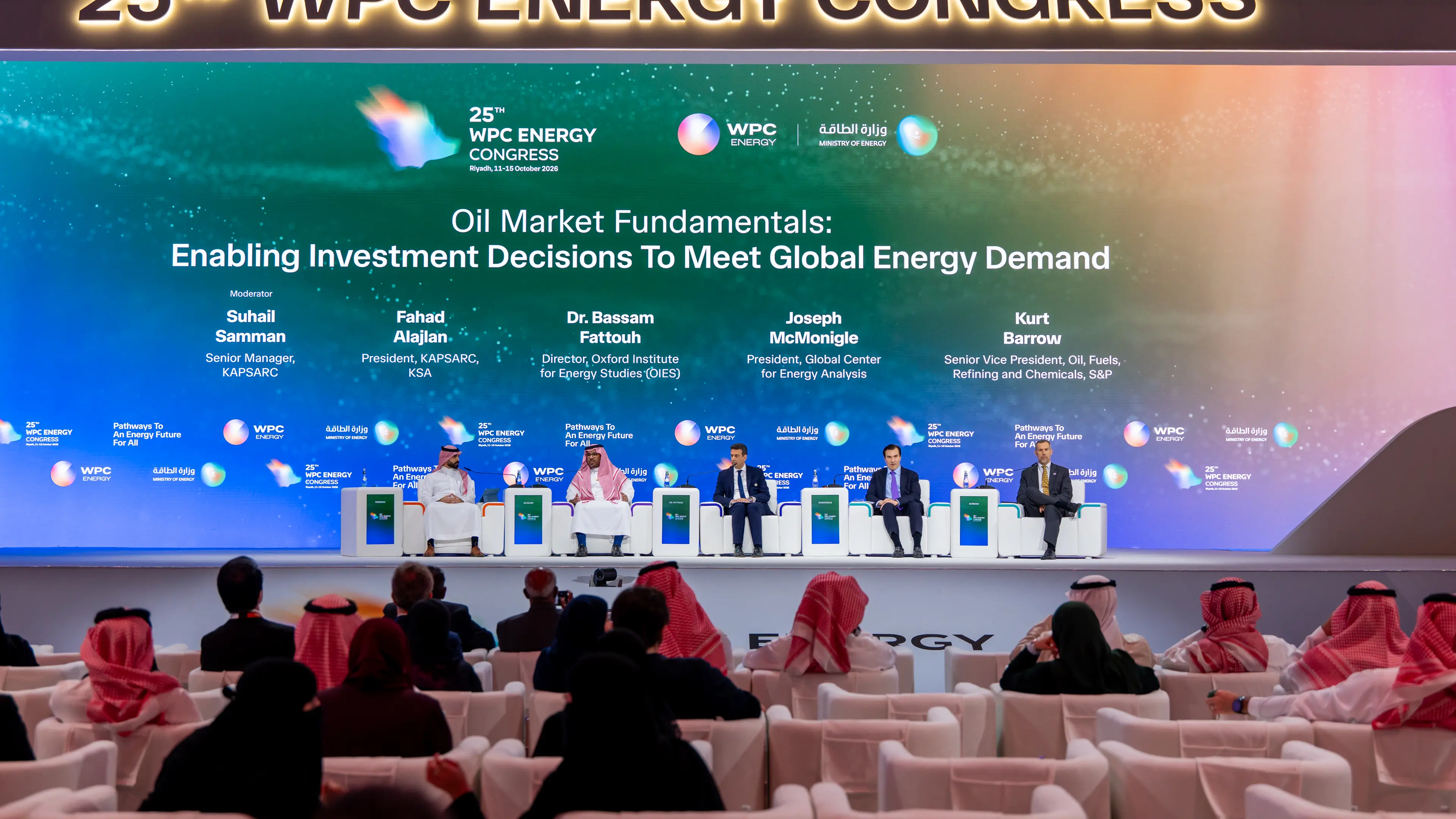
Leading energy experts discuss oil market fundamentals, global energy demand and investment decisions during Plenary Session 6 at the 25th WPC Energy Congress in Riyadh.
Capacity or commitment | Figure cited | Prinicipal institution |
Spare crude production capacity | $500 billion in estimated global economic value, as cited from KAPSARC research | OPEC, particularly Saudi Arabia |
Generation capacity under construction | 53 GW against an existing system of approximately 105 GW | Principal Buyer |
Data-centre demand on distribution networks | More than 150 MW served; over 20 facilities in one city | Saudi Energy |
National ICT framework agreements | More than SAR 60 billion across seven agreements | Digital Government Authority |
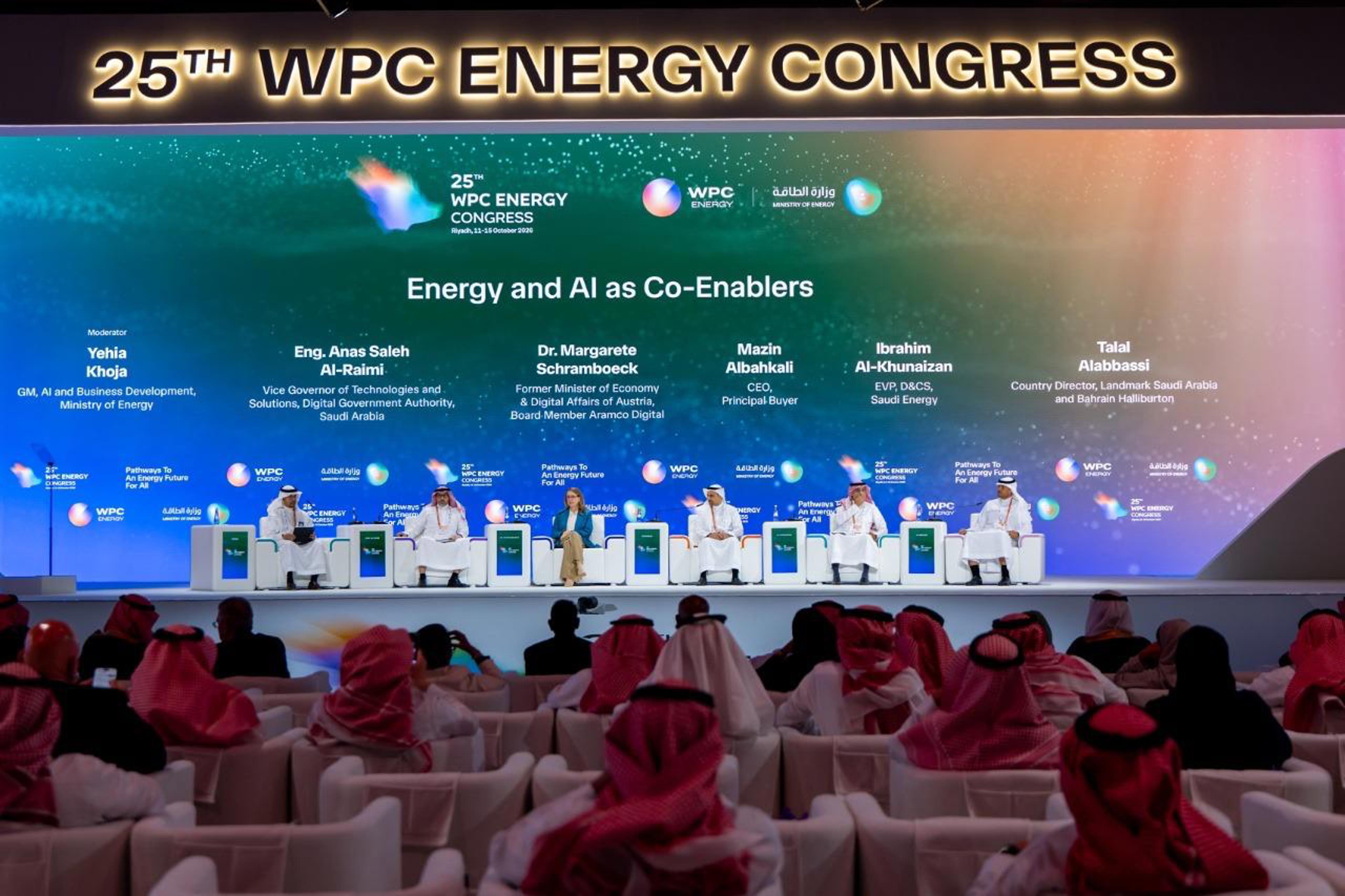
Industry leaders explore the growing relationship between energy and artificial intelligence, focusing on electricity demand, grid resilience and digital transformation during Plenary Session 5 at the 25th WPC Energy Congress in Riyadh.
The pilot proves the technology. Scaling proves the business model.
Dr Margarete Schramboeck, board member of Aramco Digital and former Austrian Minister for Economy and Digital Affairs, offered a useful distinction between experimentation and commercial deployment.
A pilot proves that the technology works. Scaling proves that the business model works.
Her starting point was deliberately practical: collect the data at the edge, where the machine operates, before attempting to build increasingly sophisticated applications on top of it.
Her assessment of Saudi Arabia's existing industrial data advantage was equally direct.
Aramco's MetaBrain contains ninety years of operational knowledge. Schramboeck said she had seen nothing comparable elsewhere in the world.
She also highlighted the demographic advantage. Austria's average age, she noted, is between 45 and 48, against 26 in Saudi Arabia.
That combination of accumulated industrial knowledge and a relatively young population provides the backdrop for the Kingdom's ambitions to scale AI beyond isolated pilots.
Al-Khunaizan supplied the operational evidence.
Demand forecasting accuracy has improved from 95 to 98 per cent. Drone and handset imagery is feeding a defect-detection model operating at 90 per cent accuracy, now being scaled across the distribution network.
Twelve million smart meters are generating increasingly granular consumption data, including appliance-level insights. Customers accessed that information through the utility's application four million times in September alone.
These are not theoretical AI use cases. They are applications already delivering measurable improvements in forecasting, inspection and customer engagement.
Engineer Rami Yassine of Halliburton, a company with nearly eight decades of experience in the Kingdom, described a parallel transformation in drilling.
AI is compressing the planning-to-execution cycle in an industry that once called exploration wildcatting precisely because it involved a considerable degree of intelligent guesswork.
The commercial distinction matters. Demonstrating that an algorithm works is only the beginning. Proving that it can deliver repeatable value across a large industrial operating base is where technology starts to become an investment proposition.
SAR 60 billion of procurement already on the page
Engineer Anas Saleh Al-Raimi, Deputy Governor for the Technology and Solutions Sector at the Digital Government Authority (DGA), brought the discussion back to the procurement pipeline.
The DGA's 2025 Government ICT Spending Report recorded SAR 31.9 billion in expenditure, with cloud spending increasing 42 per cent and expenditure on AI and emerging technologies rising 20 per cent.
That investment generated more than SAR 9.5 billion in direct economic value added.
Beyond annual expenditure, seven active national framework agreements cover more than SAR 60 billion in spending commitments or procurement scope, according to the figures presented at the Congress.
They include approximately 400 AI services, with plans to expand the offering to 1,400 by the end of the year.
Saudi Arabia also recorded one of the highest scores in the World Bank's 2025 GovTech Maturity Index, a performance the Kingdom's authorities have described as placing it second globally.
An AI-first government policy and a responsible AI adoption framework, developed with the Saudi Data and Artificial Intelligence Authority (SDAIA), are under consultation ahead of planned publication before year-end.
Al-Raimi's message on AI sovereignty was less about excluding international providers than shaping the terms of their participation.
Localise with global providers and build in Saudi Arabia.
That is an important distinction for international technology companies considering the market. Sovereignty, in this formulation, is compatible with foreign participation, provided the capabilities, partnerships and delivery infrastructure are established locally.
For suppliers, the DGA's framework agreements give that message an identifiable commercial route to market.
Reporting from inside the hall
Inside Saudi is covering the full 25th WPC Energy Congress from the floor, with access to plenaries, panels and interviews with key decision-makers throughout the week.
Two days in, the investment read-across for incoming operators is becoming clear.
Start with market access. Assess Regional Headquarters licensing requirements for relevant government procurement, establish the appropriate local presence and begin vendor prequalification well before a tender appears.
For energy and infrastructure contractors, that means understanding Saudi Aramco's vendor registration and qualification processes, positioning for midstream expansion and aligning capabilities with the Principal Buyer's generation and system requirements.
For technology providers, it means examining the DGA's national framework agreements, identifying routes into government procurement and developing the local partnerships needed to move from pilot projects to delivery at scale.
The two plenaries approached the energy system from different directions, but arrived at the same commercial conclusion.
Oil markets need spare capacity and alternative routes to withstand disruption. Electricity networks need dispatchable supply, storage and increasingly intelligent infrastructure to manage a new generation of volatile demand.
Both require capital committed in advance of the moment it is needed.
Riyadh's investment signal is not simply about producing more energy. It is about protecting the capacity to deliver it.
That is where the next wave of opportunities is forming: in the pipeline, on the grid and across the digital systems connecting them.
Resilience capacity is bought long before the disruption arrives.
So are the vendor relationships and registrations that make supplying it possible.