Wednesday, 21 October, 2026
Aramco’s Amin Nasser makes the case for energy resilience amid global supply disruptions
At the WPC Energy Congress in Riyadh, Aramco’s CEO warned of prolonged market pressures while outlining the Kingdom’s investments in supply security, industrial resilience and energy diversification.
Inside Saudi
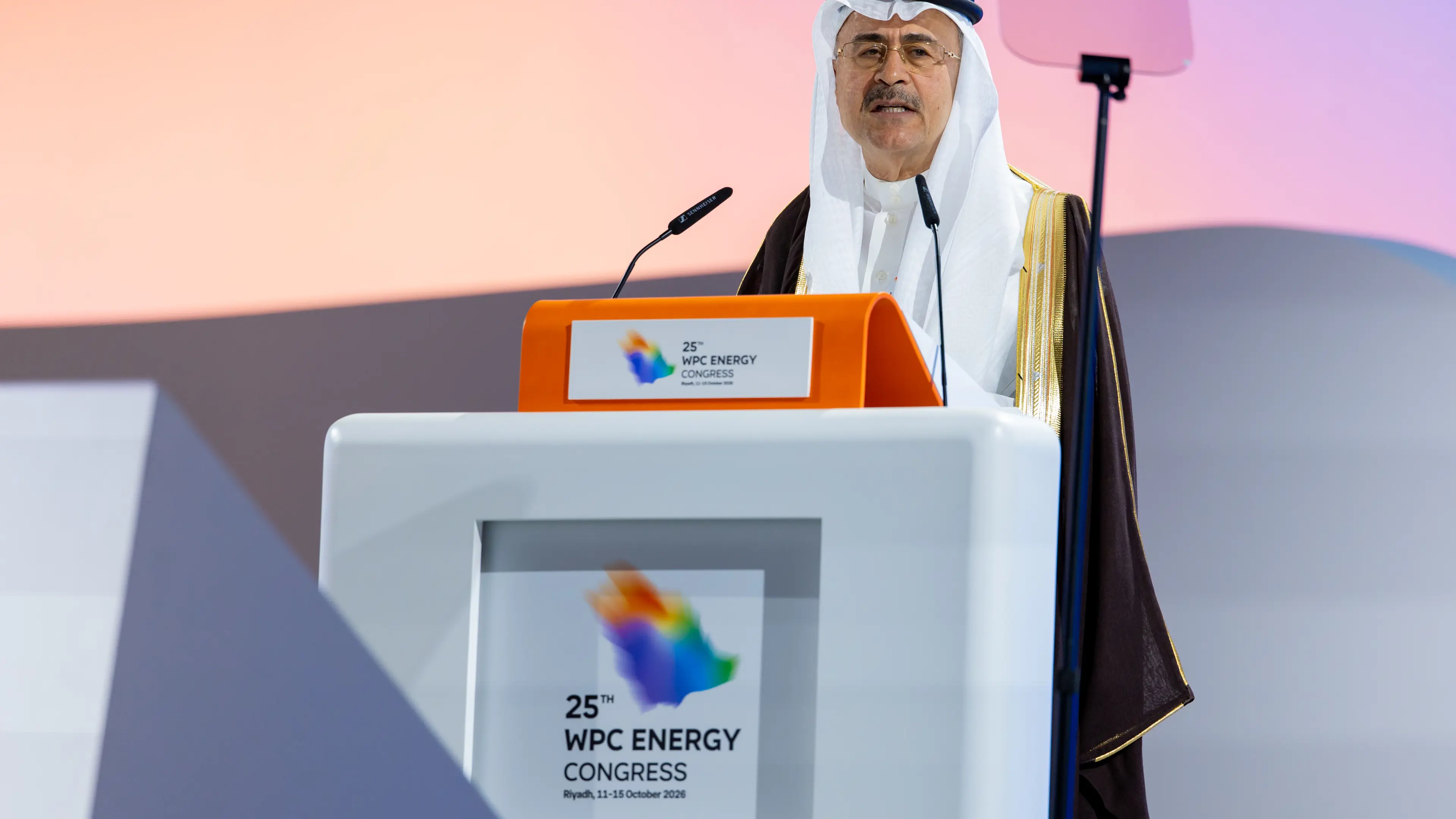
Amin Nasser, President and CEO of Saudi Aramco, delivering his keynote address at the 25th WPC Energy Congress in Riyadh on 12 October 2026.
Saudi Aramco President and CEO Amin H. Nasser has warned that disruptions to energy infrastructure and trade through the Strait of Hormuz have exposed vulnerabilities in global energy markets, underscoring the importance of long-term investment in resilient supply systems.
Leading the world’s largest oil company by crude oil production, Nasser addressed the 25th WPC Energy Congress in Riyadh on October 12, outlining mounting pressures on global energy supplies.
He said diesel prices had reached approximately $200 per barrel, while commercial onshore inventories had fallen well below six billion barrels, much of which was effectively unavailable.
“In fact, the inventory cushion is barely a cushion at all, and can never be a permanent solution to energy security,” he said.
Nasser cautioned that replenishing inventories while meeting demand could take up to two years, even after trade flows recover.
He presented resilience as central to Aramco’s strategy, encompassing spare production capacity, diversified export routes, cybersecurity, financial strength and rapid operational recovery.
“Resilience that is designed, engineered, and built long before a crisis is therefore crucial,” he said.
In coordination with the Ministry of Energy, Aramco is studying additional crude export routes and working to expand overseas storage capacity.
Nasser also emphasized the importance of domestic infrastructure, particularly the Master Gas System, which supports electricity generation, desalination, refining, petrochemicals and industrial activity.
Localization has proved equally important. According to Nasser, more than 90% of materials used to restore operations during the disruption were sourced domestically, enabling recovery in hours or days rather than weeks or months in many cases.
“In a crisis, localization is an economic multiplier, and our inner strength,” he said.
Nasser also highlighted the economic value of resilience, observing that the costs are borne by infrastructure investors while the benefits extend across entire economies. Greater market recognition of those benefits, he argued, would help sustain long-term investment.
Looking ahead, he reaffirmed Aramco’s target to increase sales-gas production capacity by approximately 80% by 2030 against 2021 production levels. Together with renewable energy development, gas expansion supports Saudi Arabia’s ambition to generate electricity equally from gas and renewables by 2030.
He also highlighted opportunities in hydrogen, carbon capture, circular carbon technologies and artificial intelligence.
Turning to global energy transitions, Nasser argued that national pathways must reflect different economic circumstances, particularly in developing economies where affordable energy remains essential to industrialization and rising living standards.
He stressed the Middle East’s enduring significance, citing its concentration of proven oil reserves and spare production capacity.
“Markets can diversify suppliers. They cannot diversify geology,” he said.
His address ultimately positioned resilience as both a foundation of Saudi Arabia’s economic transformation and a shared international responsibility, requiring sustained investment, diversified infrastructure and collective efforts to protect critical energy routes.
Aramco
Saudi Arabia
Inside Saudi
25thWPCEnergyCongress
Energy Security