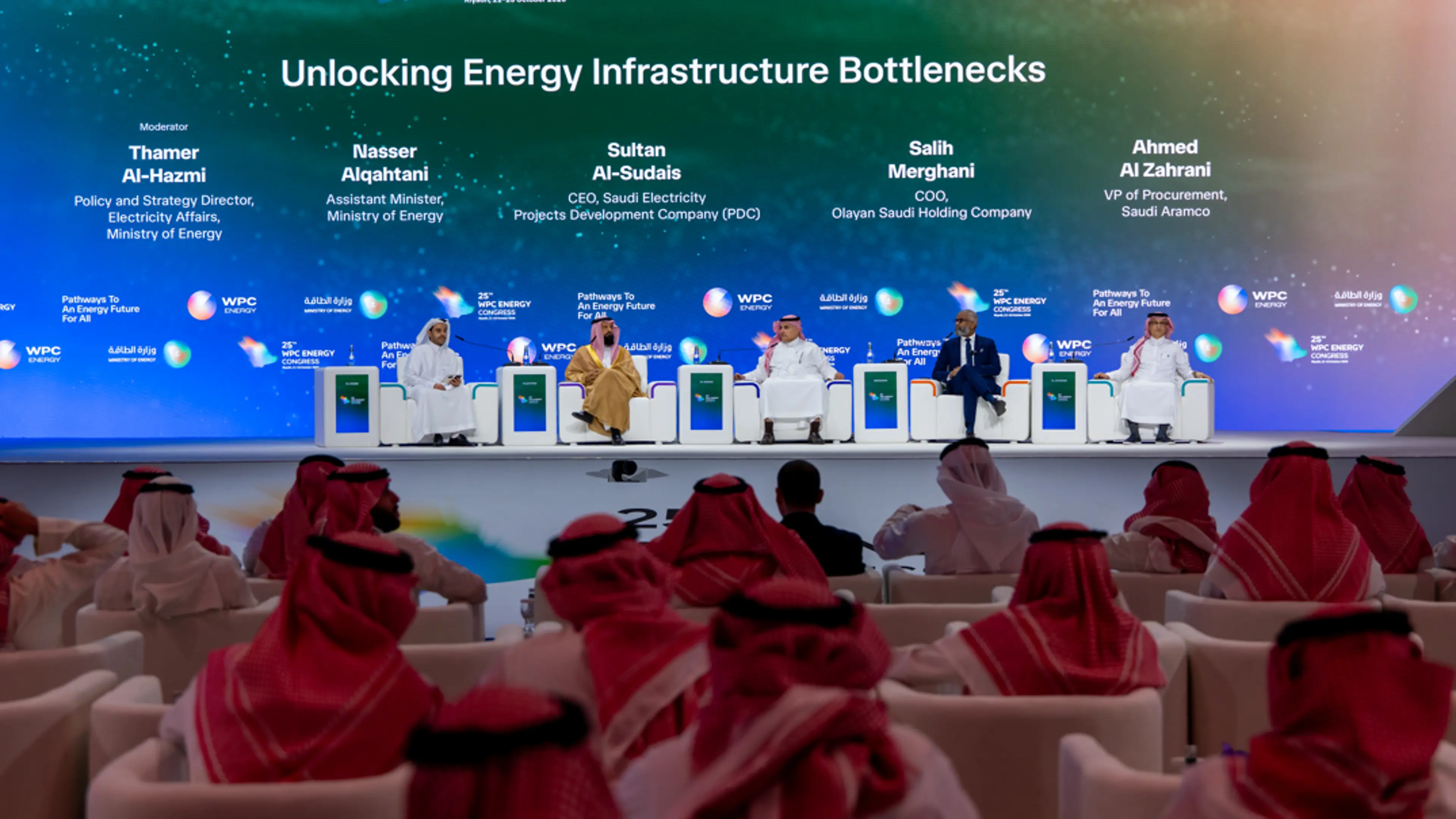
Heavy industry moves in decades, which is what makes one figure presented in Riyadh on 14 October particularly significant for businesses and investors. When Saudi Aramco launched Iktva, its flagship localisation programme, in 2015, local content in the procurement of goods and services stood at 35 per cent. It now stands at 70 per cent. Ahmad Al-Zahrani, Vice President of Procurement at Saudi Aramco, put the rest of the arithmetic on the record: $280 billion contributed to the Kingdom's GDP, more than 200,000 jobs, and 400 local manufacturing facilities established since launch with roughly $9 billion of capital behind them.
What resilience actually bought
The proof came in restoration work. Ninety per cent of the materials used to bring critical facilities back quickly were sourced locally — not a procurement statistic but the return on a decade of prior investment, and the moment localisation stopped being a compliance line and became supply-chain insurance. Al-Zahrani's division deals with more than 20,000 suppliers globally and holds over 300 corporate procurement agreements with local and international manufacturers, worth $50 billion in total. Every one carries localisation requirements written into the contract.
"Resilience should be designed, engineered and built long before the crisis happened." — Amin Nasser, as quoted to the Congress.
Certainty, not subsidy
Eng. Salih Marzani, Chief Operating Officer of Al-A'yan Saudi Holding, named the real constraint: not money, but certainty of demand. A project returning 15 to 18 per cent loses three to four points if it slips eighteen months. Investors want predictability, not speed. The Ministry of Energy has supplied the structure — Eng. Nasser Al-Qahtani, Assistant Minister for Electricity Affairs, set out planning horizons running to 2040, offtake guarantees of at least 25 years for power developers, and a SAR475 billion investment plan financed from 2021 to 2030. The result is the world's lowest levelised cost of electricity for both solar and wind.
Where the next factories go
Eng. Sultan Al-Siddiq of the Saudi Electricity Project Development Company pointed to GIS, transformers and insulators already made in the Kingdom, cutting two months from delivery schedules. The open ground is turbines, where backlogs exceed ten years, alongside gas compression, high-precision equipment, castings and forgings. SPARK and International Maritime Industries are the anchor platforms; Aramco's localisation team is the single point of contact.
Three consecutive years of tendering 20 gigawatts of renewables is an order book published in advance. The factories built against it now are the ones that will be shipping in 2030.