Thursday, 15 October, 2026
Saudi Arabia’s Energy Transformation Opens New Frontiers for Industrial Investment
From expanding domestic manufacturing to emerging lithium, solar and digital energy industries, Saudi leaders outline achievements and future investment opportunities across the Kingdom.
Inside Saudi
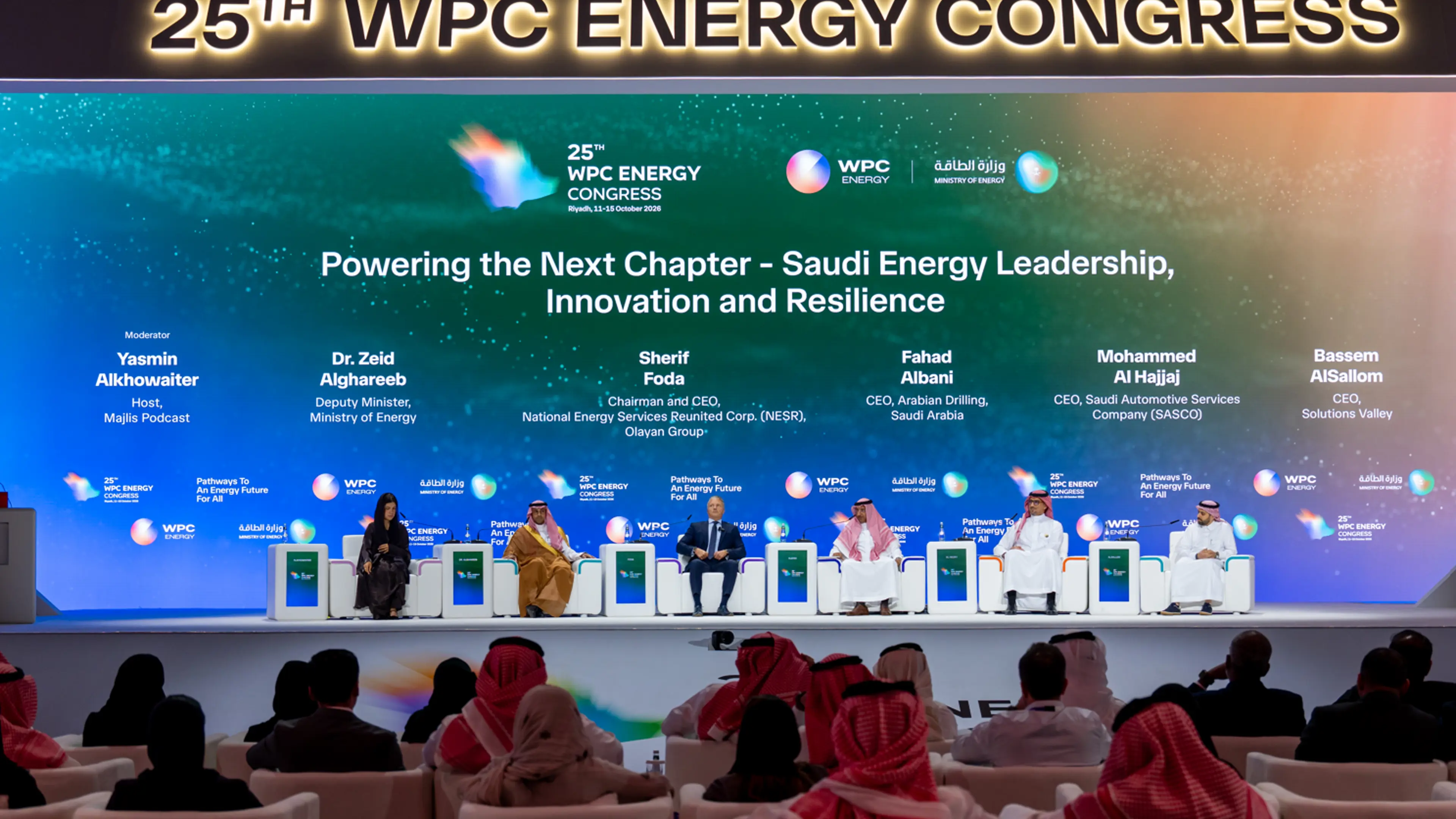
Government and industry leaders discuss Saudi Arabia’s expanding energy investment opportunities, from industrial localisation and domestic manufacturing to natural gas, renewable energy, critical minerals and digital innovation, during the “Powering the Next Chapter” plenary session at the 25th WPC Energy Congress in Riyadh, 14 October 2026.
RIYADH — Saudi Arabia is building on its established energy leadership to develop new industries, strengthen domestic supply chains and expand investment opportunities across its energy value chain.
Speaking at the Powering the Next Chapter plenary on 14 October 2026, Deputy Energy Minister Dr. Zaid Al-Gharib highlighted progress in industrial localization.
According to Al-Gharib, the Kingdom has identified 108 priority energy components for domestic manufacturing. Since 2023, approximately 103 factories have been established and are preparing for operations, while another 100 are under construction.
“We want to supply all of our projects and also we want to export these energy components,” he said, identifying domestic manufacturing and export-oriented production as strategic priorities.
Natural gas and renewable energy remain major areas for future expansion. Fahad Al-Badi, CEO of Arabian Drilling, highlighted the Jafurah unconventional gas development, citing projected production of 2 billion standard cubic feet of gas and 450,000 barrels of condensate daily.
He also reiterated the Kingdom’s 2030 ambition for renewables to account for 50% of electricity generation, a target rather than an achievement already reached.
Critical minerals could unlock another industrial value chain. Sharif Foda, Chairman and CEO of National Energy Services, reported a successful lithium-extraction pilot conducted with Aramco using oilfield brine.
He described a subsequent demonstration project designed to produce 2,000 tonnes of lithium annually, with potential longer-term expansion to 30,000–40,000 tonnes. Domestic battery manufacturing remains a prospective downstream opportunity.
“For the kingdom it's a security of supplies and another avenue of growth,” Foda said.
Digital technologies are already being deployed, while new commercial opportunities are emerging. Al-Badi described Arabian Drilling’s existing use of AI-powered safety monitoring and predictive maintenance.
Bassem Salaam, CEO of Solutions Valley, highlighted implemented drone-based grid inspections and identified opportunities in predictive analytics and distributed solar projects serving data centres and mining operations.
Mohammed Al-Hajjaj, CEO of Saudi Automotive Services Company, outlined plans for modern service stations, EV charging and integrated mobility services combining energy, retail and logistics.
Together, these initiatives reflect a growing range of investment opportunities across manufacturing, gas, renewables, critical minerals, digital energy services and mobility infrastructure, combining operational achievements with projects under development and longer-term industrial ambitions.
Saudi Arabia
25thWPCEnergyCongress
Investment
Energy
Inside Saudi