Wednesday, 21 October, 2026
Bahri CEO calls for resilient global supply chains as transport and digital infrastructure converge
At the WPC Energy Congress in Riyadh, industry and government leaders examined how maritime logistics, digital technologies and energy infrastructure can evolve together while safeguarding the reliability of global trade.
Inside Saudi
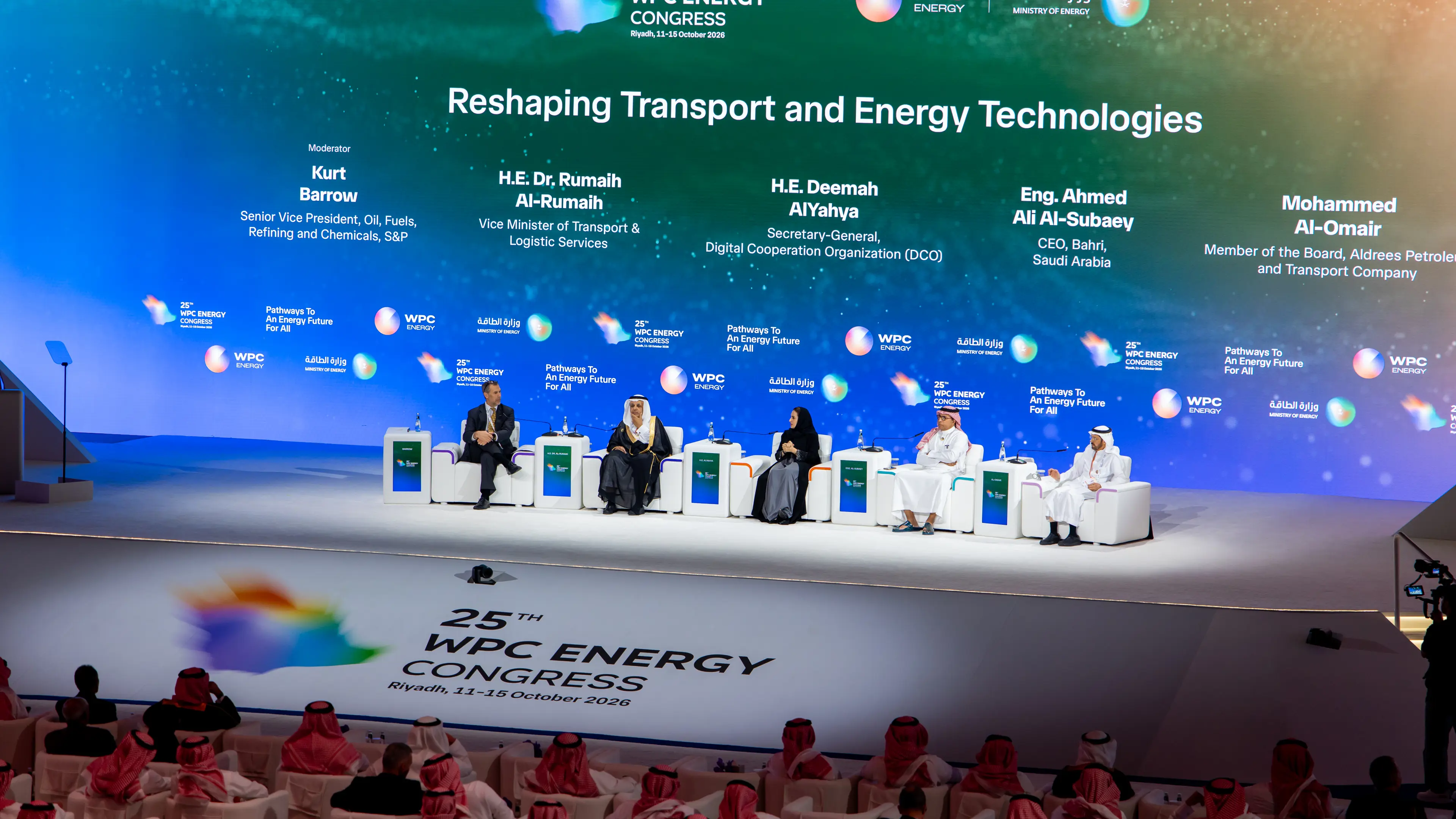
Industry and government leaders discuss the future of transport and energy technologies during the “Reshaping Transport and Energy Technologies” panel at the 25th WPC Energy Congress in Riyadh.
Safeguarding global trade while advancing transport decarbonization requires diversified supply chains, coordinated infrastructure investment and stronger digital resilience, Bahri CEO Ahmed Ali Alsubaey told the 25th WPC Energy Congress in Riyadh.
Speaking during a plenary discussion on Reshaping Transport and Energy Technologies, Alsubaey warned against pursuing technological and environmental changes that could compromise the reliability of maritime transport, particularly amid disruptions to regional supply chains.
One of the world’s largest owners of very large crude carriers, Bahri ended 2025 with an owned fleet of 104 vessels, including 50 crude supertankers, and reported annual revenue of SAR 10.35 billion.
Calling the gathering a “defiant Congress”, Alsubaey described the pressures confronting shipping operators and their partners, including government authorities, ports and industrial customers such as Aramco and SABIC.
“Every part of the sector has been stretched, to say the least,” he said.
For Alsubaey, the challenge is to decarbonize shipping without undermining the global trade networks it serves.
“It's not a matter of whether deep-sea shipping will decarbonize. We will,” he said. “But can we do it without disrupting the reliability of global trade?”
He argued that meaningful decarbonization requires an entire supporting ecosystem, bringing together new technologies, infrastructure, investment, international partnerships and skilled personnel.
Questioning the environmental trade-offs of open-loop exhaust-gas cleaning systems that discharge washwater into the sea, he warned: “You're transferring the problem, not transitioning.
Alsubaey also cautioned against imposing uniform transition timetables across transportation sectors. Aviation and deep-sea shipping, he argued, face energy-intensity and infrastructure challenges distinct from those of passenger vehicles.
Looking towards 2030, he placed diversification at the centre of infrastructure investment.
“You cannot rely on one mode of supply chain and transportation,” he said, advocating investment in inland ports, vessels, pipelines, railways, aviation and bonded logistics corridors to strengthen connectivity and reduce vulnerability to disruption.
The emphasis on resilience extended beyond physical transport networks. As shipping and logistics become increasingly dependent on digital systems, operational continuity also requires secure connectivity, reliable electricity and protection against technological disruption.
Deemah AlYahya, Secretary-General of the Riyadh-based Digital Cooperation Organization (DCO), a 16-member intergovernmental body promoting digital transformation and cooperation, examined this growing dependence.
She highlighted artificial intelligence’s potential to improve navigation, logistics efficiency and energy consumption through better route planning and more productive use of transport capacity.
However, she cautioned that digitalization also increases electricity demand and creates vulnerabilities as essential services become increasingly reliant on interconnected technologies and a limited number of providers.
“Resilience should not be an afterthought,” she said, advocating its incorporation into the design of energy and digital infrastructure.
AlYahya emphasized stronger domestic technological capabilities, diversified connectivity and closer cooperation with private investors, particularly in developing data centres, submarine cables and other critical infrastructure.
She also highlighted risks to maritime navigation and communications networks, citing interference she said had affected vessels in the Bab el-Mandeb corridor.
“This is where we have been working heavily the past couple of months on bringing this issue to the Security Council, actually the UN Security Council, to include digital infrastructure to be protected,” she said.
AlYahya advocated protecting digital connectivity alongside essential services such as electricity and water during conflicts and environmental disasters. She identified alternative cable routes, satellite connectivity, cybersecurity and technical talent as important elements of resilience.
Saudi Arabia’s Vice Minister of Transport and Logistic Services, Dr. Rumaih Al-Rumaih, placed these challenges within the Kingdom’s transport transformation, emphasizing that decarbonization requires a diversified energy mix rather than a single technological solution.
He outlined trials involving hydrogen trains and trucks and electric vessels, while identifying aviation and maritime transport as particularly difficult to decarbonize because of their long-distance operations and dependence on international infrastructure.
Al-Rumaih also highlighted Riyadh’s approximately 187-kilometre metro network and 85 stations, alongside expanding bus services. He described public-private partnerships and concessions across ports, airports and transport services as important mechanisms for infrastructure development.
Representing the fuel distribution sector, Aldrees board member Mohammed Alomair explained how electric mobility will reshape service stations, requiring reliable electricity distribution, charging infrastructure and facilities adapted to longer customer visits.
The discussion ultimately revealed how closely physical logistics, digital connectivity and energy infrastructure are intertwine.
“You create resilience not when the disruption happens. You create it before the disruption happens,” Alsubaey said.
AlYahya reinforced that message, calling for “diversification, resilience by design” and greater domestic technological self-sufficiency.
While Alsubaey emphasized diversified supply chains and pragmatic decarbonization, AlYahya focused on protecting the digital systems underpinning those networks. Al-Rumaih highlighted multimodal connectivity and flexible energy solutions, while Alomair illustrated the operational changes required by emerging mobility technologies.
Together, their contributions pointed to a common priority: embedding resilience into infrastructure and investment decisions before disruption occurs.
Bahri
25thWPCEnergyCongress
Inside Saudi
Saudi Arabia
Transport
Digital infrastructure
Energy Infrastructure
Global